
Introduction
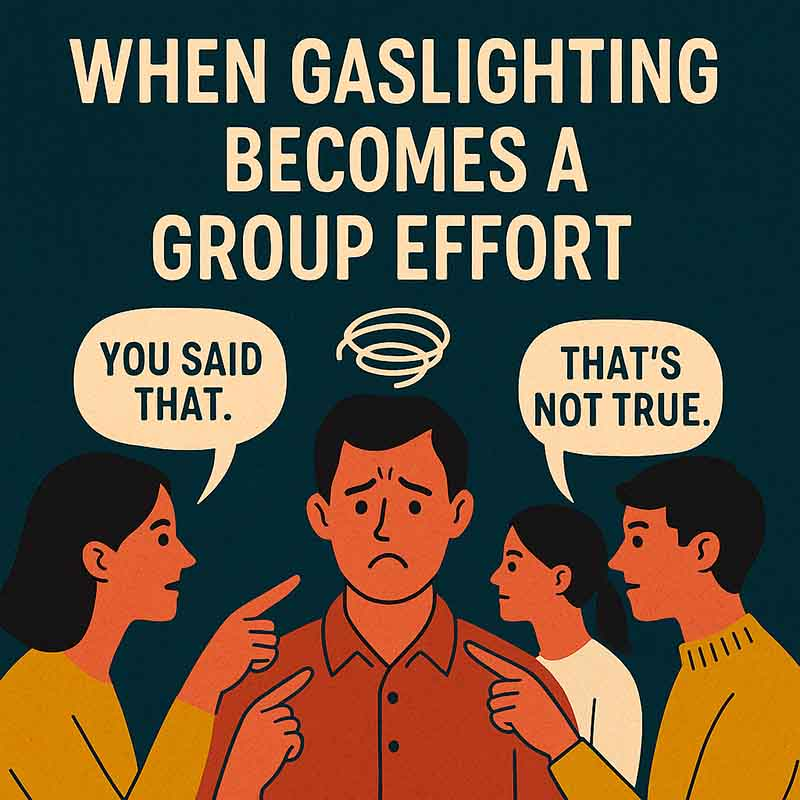
Gaslighting doesn’t always come from one person. Sometimes several people build and repeat the same story. This creates doubt, isolates you, and pressures you to accept their version of events. This post explains how that pattern works and how to respond.
A Real Moment — October 4th 2025
My son once told me he wanted to play club soccer. I felt proud. A short time later, I received a group text from Coach about reopening sign ups. He asked me to let my son know.
Weeks later, we sat at a party—Coach, my son, my daughter, their mother, and me. I brought up the text and asked if my son still wanted club soccer. He said he never said that. He added that he wanted one more year of U19 with his sister. No one else spoke. The topic shifted. I felt the ground move under me. I knew what this was.
What Group Gaslighting Is
Group gaslighting is a coordinated pattern. People act in ways that make you doubt your memory and judgment. Each person plays a part. The effect builds over time.
How the Pattern Works
Roles can look like this:
- One person denies clear facts.
- Another stays silent to signal agreement.
- Someone changes the subject at key moments.
- Others repeat the same phrases later.
None of these moves look extreme on their own. Together, they create a false story and social pressure to accept it.
Why It Feels Convincing
- Repetition makes the story seem normal.
- Silence looks like proof.
- Numbers create the appearance of consensus.
- Your need to keep peace makes you doubt yourself.
Signs You Are Facing a Group Narrative
- Several people use the same words to describe you or an event.
- People who were neutral begin to distance themselves at the same time.
- Private details appear in other conversations without context.
- When you raise facts, the focus shifts to your tone or your reaction.
What to Do in the Moment
- Stay calm. Breathe before you speak.
- State one clear fact. Do not argue every point.
- Decline the trap. Say, “I remember it differently,” and stop there.
- Leave the setting if you feel pressured.
Protect Your Reality Over Time
- Write brief notes with dates and facts.
- Save neutral records when possible.
- Limit one-on-one talks with known participants.
- Do not share private details with people who relay them.
- Choose one trusted person outside the circle to sanity-check key events.
What Not to Chase
- Do not chase public approval. You will not get it from the group.
- Do not re-litigate old scenes over and over.
- Do not explain yourself to people who show bad faith.
Healthy Boundaries
- Decide what topics are off limits.
- Set time limits for tense talks.
- Reduce contact when patterns repeat.
- Prioritize spaces where you feel calm and respected.
Recognizing and Stepping Back
When several people participate in gaslighting, you stop looking for the truth in their words and start watching their patterns. Silence, timing, and repetition reveal more than dialogue ever will. The hardest part is accepting that you may never get acknowledgment or closure from those involved. The only way to regain balance is to stop reacting to their script. Once you stop defending what you know is true, their control over your perception breaks. Awareness becomes your protection.
Closing
Group gaslighting is coordination, not confusion. Watch patterns more than words. Keep your records short and factual. Protect your attention. You do not need the group to confirm your reality to live by it.